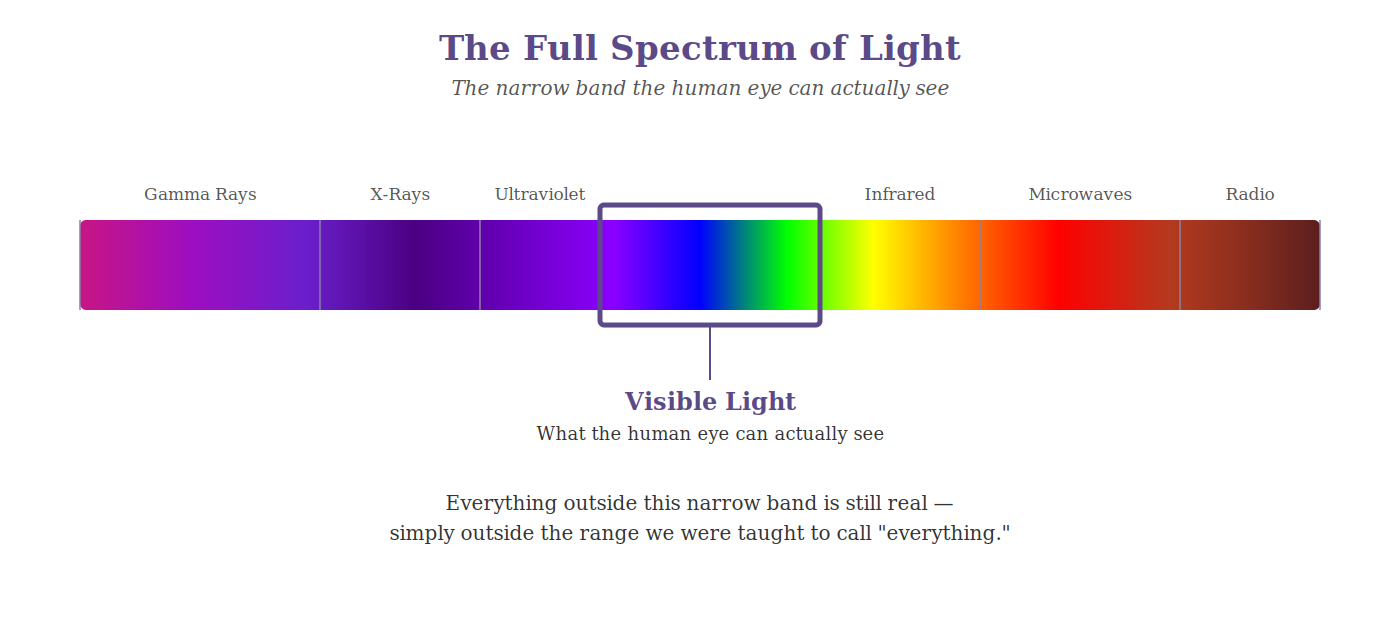
The human eye sees a sliver of the full spectrum of light. Everything outside that narrow band is still real — infrared, ultraviolet, radio, all of it. Real, present, and simply outside the range we were taught to call “everything.”
The conventional world tells us, through school, media, and science, that we humans are cells, atoms, carbon-based, oxygen-breathing mammals with a certain expected life span — and that we have five senses. Sight, sound, touch, taste, smell. Only those five.
We're told we have emotions, but with much less consensus about what they're for, how they work, or why we'd want them. Mostly they seem to cause trouble — especially the “bad” ones, like anger, jealousy, depression. And there's an opposite camp, where feelings are utterly glorified, where you can know things by emotion alone and to heck with facts and reason.
Thinking has its two camps too. Glorified as the pinnacle — the fabulous Analyzer, the Ivy League gold standard, mind vastly superior to body and certainly to emotions. Or distrusted entirely, the long-documented anti-intellectual streak.
Overvalued or undervalued, there's not a lot of equanimity — or comprehension — about thinking or emotions in everyday life.